I don’t Know
*This article was originally written in Chinese, translated into English by ChatGPT, and reviewed by Liying.
After coming to the United States, I found that the acupuncturists come from many different educational backgrounds. I think this is a good thing. For those of us who received formal Traditional Chinese Medicine (TCM) training, it gives us a chance to see different perspectives.
My education started with TCM, and Western medicine came later. When I entered TCM school as a freshman, each of us was given a copy of Selected Readings from the Huangdi Neijing. Every morning we memorized the key passages our professors marked. We had no idea what they really meant or how they would be used in clinical practice. We just memorized them and took the exams.
We did not formally study the Huangdi Neijing until the second semester of our sophomore year. Before that, for nearly two years, we simply memorized it repeatedly.
We did not begin studying Internal Medicine until the second semester of our junior year. Of course, we had already taken Western medicine courses such as anatomy, pathology, pharmacology, and diagnostics. However, the main focus of our curriculum was still Traditional Chinese Medicine: Fundamentals of TCM in the first semester of freshman year, TCM Diagnostics and Chinese Herb in the second semester, and TCM Herbal Formula in the first semester of sophomore year.
Before we were introduced to the systematic diagnosis and treatment methods of Western medicine, we had already learned how to use Chinese herbs and herbal formulas to treat many symptoms and diseases.
Many of these things felt completely natural to us. In China, they are simply part of the medical culture, and people rarely question them. But in the United States, especially in the Midwest, many patients are receiving acupuncture for the first time. Some ask whether acupuncture needles contain special medicine. Others ask whether the needles are reused. The most common question, of course, is, "Why does acupuncture work?"
In China, you might explain that a patient has Kidney Yin deficiency or a lack of communication between the Heart and the Kidney( xin shen bu jiao, 心肾不交). You could even use an example from the I Ching: the harmony of the Heart and Kidney is represented by the Jiji Hexagram (Hexagram 63), where water and fire are in balance; the lack of harmony is represented by the Weiji Hexagram (Hexagram 64), where water and fire fail to connect. Therefore, symptoms such as irritability, insomnia, and hot flashes may appear.
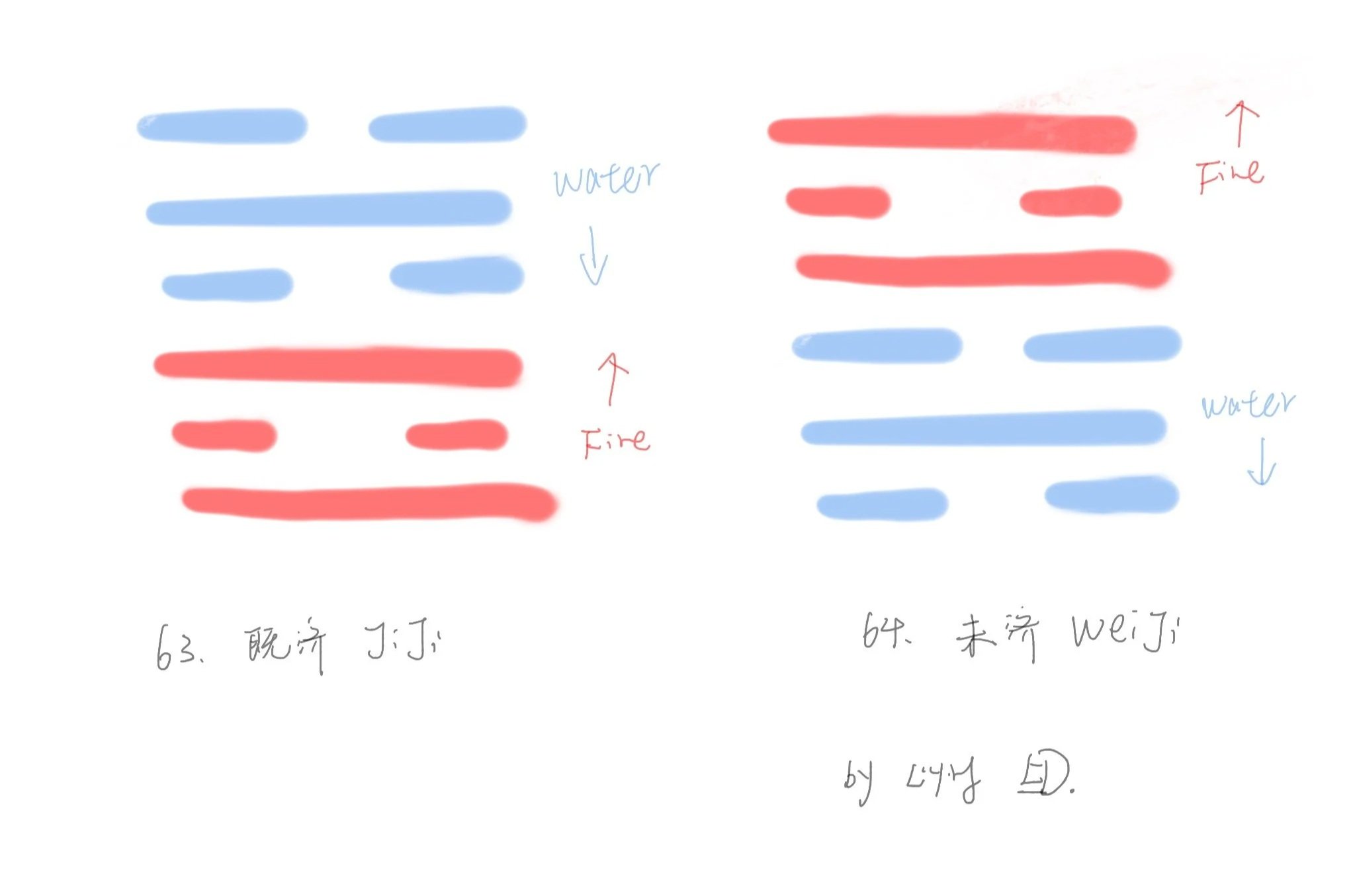
But in the United States, I cannot explain it that way.
The most useful language here is anatomy. If you start talking about molecular biology or signaling pathways, most patients cannot follow. More importantly, TCM theory does not have a one-to-one correspondence with Western anatomy, pathophysiology, or molecular biology.
And honestly, I do not even know how to explain concepts like water and fire, or the Hexagram. Should I draw them? Appointment time is limited, and my English is not good enough for that kind of discussion. So people from different professional backgrounds may have their own ways of explaining it.
I have noticed that many formally trained Chinese acupuncturists naturally explain things using the Five Zang organs (Heart, Liver, Spleen, Lung, and Kidney), Yin and Yang, Qi, and Blood. That makes perfect sense, because this is how we were trained. But if the conversation moves into the Six-Conformation Pattern Identification (Taiyang, Yangming, Shaoyang, Taiyin, Shaoyin, and Jueyin), even explaining what the Six-Conformation are can become a challenge.
After spending so much effort explaining everything, the response is often just one word:
"Interesting."
So why force it?
In May, I developed a severe allergic reaction of unknown cause. I saw my primary care physician, went to the emergency department, and was eventually hospitalized. The phrase I heard most often from the doctors was:
"I don't know. Let's see."
Even though no one ever found the exact cause, I eventually recovered.
That experience taught me something important.
If anatomy can explain it, I explain it. If it cannot, I do not force an explanation.
I simply say,
"I don't know."
